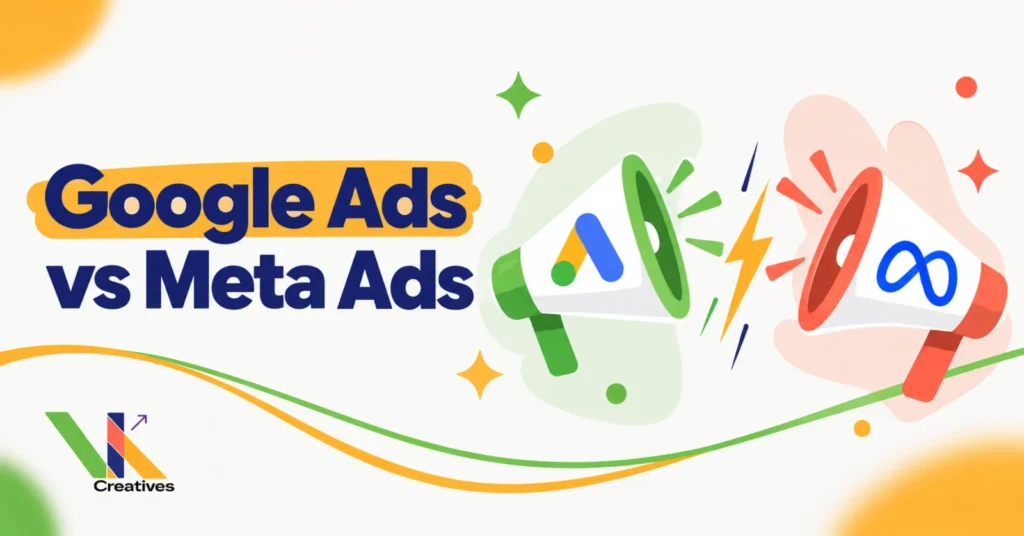
Short answer: start with Google Ads if people already search for what you sell (a clinic, a CA firm, a flat in Salt Lake). Start with Meta Ads if your product is new, visual or needs awareness first (a D2C skincare brand, a launch offer). Most Kolkata businesses end up using both, so the real question is which one gets your first testing budget.
Google Ads vs Meta Ads in one line: Google Ads captures existing demand from people actively searching. Meta Ads (Facebook and Instagram) creates demand by reaching people while they scroll.
Why does this question trip up so many Kolkata businesses?
A restaurant owner on Park Street asks us to “just run some Facebook ads” because a competitor is doing it. A New Town skincare brand wants to be on Google because “that’s where people search.” A Salt Lake developer wants both immediately, because the sales team needs leads this month. None of these instincts is wrong, but none is a strategy either. The platform you start with should follow from how your customer actually buys, not from what a competitor does or what a salesperson recommended last week.
It is rarely a permanent “Google vs Meta” choice. It is “which one gets my first testing budget, and why.” Get that sequencing right and you save months of wasted spend.
What is the real difference between Google Ads and Meta Ads?
Both can drive leads and sales. What matters is where the customer is in their decision when your ad reaches them.
Google Ads is an intent channel. Someone searches “orthopaedic doctor near Salt Lake” or “best CA firm in Kolkata for GST filing” because they already have a need. Your ad competes for people who have raised their hand. Its job is not to convince them they need the service, only that you are the right choice among the results.
Meta Ads is a discovery channel. Nobody opens Instagram looking for a skincare brand or a new sofa. They are scrolling for friends, reels and news. Your ad must interrupt that scroll and create interest in something the person was not searching for. That is harder, because you are building demand, not capturing it, but it is where first-time purchases and impulse-driven categories often perform best.
This one distinction explains most “why isn’t this working” complaints. A business running Meta ads while expecting Google-level buying intent will be disappointed by lead quality. A business running Google Ads for something nobody searches for yet, such as a new D2C brand with no category awareness, will find the campaign slow because there is no search volume to capture.
Which platform fits my type of business?
Work backward from how your customer searches, browses and decides. Three examples we see often in Kolkata:
A Salt Lake real estate developer
Someone buying a flat in Salt Lake or New Town does not decide on impulse. They research for weeks, comparing builders, checking approvals and visiting sites. Close to a decision, they type “2BHK flat Salt Lake Sector 5” or “ready to move flats New Town.” That is exactly the moment Google Ads captures. Meta still has a role, building awareness of a launch or retargeting website visitors who did not fill a form, but it should not be the first channel for a developer with live inventory. Start with Google Search campaigns tied to project names and locality searches, then add Meta retargeting once there is traffic.
A New Town D2C skincare brand
Close to the opposite case. A new brand with no search demand has almost nothing to capture on Google, because nobody searches for a product they do not know exists. What works is visual storytelling: before-and-after content, ingredient stories, founder videos and creative that stops the scroll on Instagram and Facebook. Meta’s lookalike audiences let a brand find people who resemble its existing customers. Once people search the brand name or terms like “vitamin C serum for oily skin,” add Google Ads, mainly Search and Shopping.
A Park Street restaurant
Restaurants sit in between. Some diners search with intent (“best rooftop restaurant Park Street,” “restaurants open now near me”). That is Google, especially Maps and a well-kept Google Business Profile (our Google Business Profile checklist covers the steps). But much restaurant discovery is impulse: a great reel of a dish, a friend’s story, an offer post seen while deciding where to eat tonight. Both platforms usually earn their place quickly, but the content differs. Google needs an optimised profile and a fast mobile website with a clear menu and location. Meta needs consistently good food photography and video.
What mistakes do Kolkata businesses make when choosing a platform?
We see the same handful across clinics, coaching institutes, dealerships and retailers around Kolkata and Hooghly.
Copying a competitor’s channel without checking the fit
“They’re running Facebook ads, so we should too” ignores whether the competitor is getting results or just spending money. A business two doors down might run ads badly and still get walk-ins from footfall. That does not make Meta right for you.
Treating Meta as a shortcut for high-consideration purchases
We have seen coaching institutes run only Meta lead-form ads for admissions, then get frustrated by low-quality enquiries. Admissions, like real estate or healthcare, involve research and comparison. Meta can build awareness, but Search campaigns for terms like “best coaching for engineering entrance in Kolkata” usually bring better quality, because the person is already evaluating options.
Running Google Ads on broad match with no negative keywords
A dealership running Search Ads for “bike service” without excluding irrelevant searches can pay for clicks from people looking for DIY repair videos. Tight match types and a growing negative keyword list matter as much as the platform choice.
Launching without a landing page built for the ad
Sending paid traffic to a generic homepage instead of a page built around the offer in the ad wastes a test budget fast. The ad and the landing page need to match. If your site is not ready, start with our website checklist.
Judging results too early
Both platforms need a learning period. Google needs enough conversion data to optimise bidding; Meta needs enough conversion events to exit its learning phase. Pausing and restarting every few days resets that learning and almost always makes performance worse.
How can I test both without wasting budget?
You do not have to choose one forever. Start small and scale what works.
- Pick one clear, measurable goal first. A phone call, form fill, WhatsApp message or purchase, not “more visibility.”
- Run a defined test window. Give each platform a few weeks at minimum before drawing conclusions.
- Test one variable at a time. Keep the offer, landing page and tracking identical across both, so the only difference is the channel.
- Compare quality, not just volume. Fewer Google leads that become sales can beat many Meta leads that go nowhere. Track what happens after the click.
- Scale the winner deliberately. Increase spend gradually. Sudden budget jumps can disrupt delivery and temporarily hurt performance.
- Do not abandon the other channel. One that underperforms for cold acquisition can still work for retargeting people who showed interest.
Why does conversion tracking matter before I spend on ads?
None of the comparison above means much if you cannot measure what happened after the click. This is the step businesses skip most, and the biggest reason “we tried both and neither worked” turns out to be a measurement problem.
At a minimum, put these in place:
- Website conversion tracking through Google Tag Manager and GA4, so form fills, calls and key page visits count as conversions Google Ads can optimise toward.
- Meta Pixel and Conversions API, so Meta learns from real outcomes and not just clicks. This matters more now that browser privacy changes have made pixel-only tracking less reliable.
- Call and WhatsApp tracking, since a large share of enquiries in Kolkata and West Bengal come by phone and WhatsApp, not web forms, especially for real estate, healthcare, education and local services.
- A shared reporting view tying ad spend to enquiries and, ideally, sales, not just clicks, reach or impressions. Reach tells you who saw the ad, never who bought.
Without this, both platforms optimise blind. Get tracking right first and the comparison becomes far easier to judge honestly.
Should ads replace SEO?
No. Ads bring enquiries quickly but stop when the budget stops. SEO builds slower and compounds. If you are weighing the two, read our guide on how to choose an SEO company in Kolkata.
Frequently Asked Questions
Should a brand-new business start with Google Ads or Meta Ads?
It depends on whether people already search for what you sell. If there is search demand, such as for a service, a clinic or a known product category, Google Ads usually reaches ready buyers faster. If you are introducing something nobody searches for yet, Meta Ads is better at building the awareness that eventually creates search demand.
Can I run both platforms at the same time on a limited budget?
Yes, but split the budget deliberately, not evenly. Give the platform matching your customer’s buying behaviour the larger share, and use the smaller share as a genuine test.
Why are my Meta leads lower quality than my Google leads?
Often it is intent, not a flaw in Meta. Someone filling a Meta lead form while scrolling is usually earlier in their decision than someone who searched Google. Qualify leads better through ad copy, form questions or a quick follow-up call, and set expectations for the sales team.
How long should I test before deciding a platform doesn’t work for my business?
Give each platform enough time to exit its learning phase and gather conversion data: a few weeks at minimum, longer for categories with long consideration cycles like real estate or high-value B2B. Judging after a few days almost always leads to the wrong conclusion.
Do I need a separate landing page for Google Ads and Meta Ads?
Ideally yes, or at least tailored sections. Someone from a Google search has intent and wants specifics quickly. Someone from a Meta ad needs more context and reassurance, since they were not looking moments earlier.
If you would rather have this decision guided by real account data than guesswork, VK Creatives manages Google Ads and Meta Ads for businesses across Kolkata and West Bengal, from real estate developers to automobile dealerships and education institutions. See our performance marketing services, or get in touch to talk through which platform makes sense to start with.